
NEWS
TU Teen Essay Contest
This summer, Trout Unlimited wants to hear from any young person ages 12-18 why public spaces and lands are important to them. Judges will choose three winners from two categories: 8th grade to 10th grade & 11th and 12th grade. When teens enter our TU Teen Essay contest, they get the chance to win a new Temple Fork Outfitters AXIOM II flyrod and reel plus their winning essay will be published in Trout Magazine. There are also prizes for second and third place winners.
Visit www.tu.org/teen-essays for the essay prompt, contest rules and details. Contact Headwaters Youth Program staff (brett.prettyman@tu.org) with questions and to enter.
#troutunlimited #coloradotroutunlimited #coloradoconservation

JUNE CHAPTER MEETNG PRESENTATION NOW ON CCTU YOUTUBE CHANNEL
Another excellent chapter meeting last night is now up on the CCTU YouTube channel. Patrick Blackdale from Three Rivers Resort and Willowfly Anglers in Almont gave a great presentation “
SOURCE-DOWN, AN OVERVIEW OF THE UPPER GUNNISON DRAINAGE”. He gave a broad overview of the fishery, touching on high alpine lakes, small streams, freestones, tailwaters and reservoirs. Great info on locations in an excellent, photo-laden presentation. Three Rivers Resort is located in Almont, Colorado on the Taylor River. The resort features rustic cabins from the 1800s, as well as brand new cabins with the comforts of home. They have access to both public and private water and set you on amazing fish in stunning surroundings. For more info go to https://3riversresort.com/.
The presentation is available at https://www.youtube.com/watch?v=rRcT1qJWk4U.

CCTU EARTH DAY – THEN, NOW, AND THE FUTURE
In order to celebrate Earth Day in April 2021 members of CCTU recently planted native cottonwood trees and shrubs along urban Bear Creek. This project was in cooperation with the City of Lakewood and has been an annual chapter event since 2017. The project was cancelled in 2020 due to Covid-19, as were most of our chapter's other activities. It was nice to get out with friends to do something constructive for Mother Earth.
It is one thing to buy a plant, put in the ground, and then forget it. It is quite another thing to nurture that plant and ensure its long term survival and growth. The City appreciates our chapter's donation to buy these plants as well as our chapter's volunteer labor to plant them. The City takes our investment in the survival of these plants very seriously. They make sure the saplings are protected from beavers with fencing and they make a point to water the plantings regularly while the young plants are becoming established.
After the most recent Earth Day event, Jerry Shin took some time to go back and check on the cottonwood trees he helped plant in 2018 and 2019. He was glad to see those trees thriving, several feet taller and inches larger in circumference compared to when he helped put them in the ground. This is clear evidence the City intends to nurture these trees, and that those trees will be a lasting legacy for all the Cutthroat Chapter members who's fundraising and labor are helping to protect and conserve that urban riparian environment. Thanks to all their hard work these cottonwoods will likely be here years in the future, continuing to protect this urban oasis long in the future after we have passed from this Earth.
The pic with John Cristantiello and Jerry was from 2018 showing one of several cottonwoods they planted that day. The pic of Jerry alone is from 2021 showing one of those same thriving and much larger cottonwoods.

2018

2021

MAY CHAPTER MEETING PRESENTATIONS NOW ON CCTU YOUTUBE CHANNEL
We had an excellent chapter meeting last night, May 18, with two local biologists. Tawni Riepe was our Steve Bailey Memorial Scholarship recipient at CSU and a doctoral candidate at the Dept of Fish, Wildlilfe and Conservation Biology. She spoke about the growing danger of bacterial kidney disease in Colorado Trout, both hatchery and wild fish. Something few of us knew about, and definitely a looming threat. Tyler Swarr, the CPW Aquatic Biologist for the Upper South Platte Basin gave fascinating presentation on the daily/annual responsibilities of a State Fisheries Biologist. He touched on a ton of things from CPW fish sampling techniques to the role of state fish hatcheries…it is amazing the diversity of responsibilities each biologist has, and how busy they truly are across the entire year. Thanks to both speakers for excellent discussions.
Catch the presentations at the CCTU YouTube channel at https://youtu.be/XUBMGTFRn60
CCTU CONSERVATION PROJECTS ARE BACK! BEAR CREEK EARTH DAY CONSERVATION PROJECT WRAP-UP
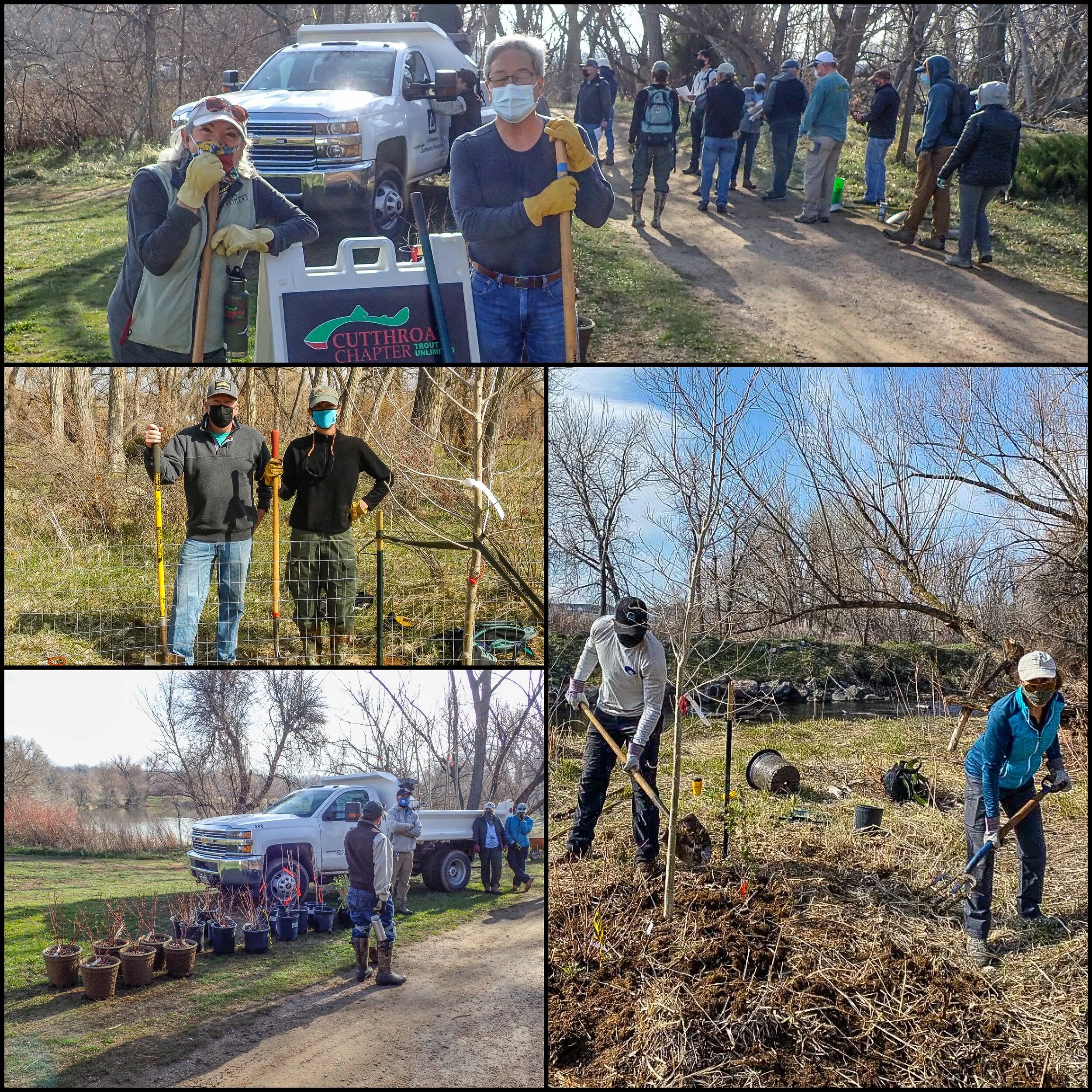
After a year hiatus due to Covid concerns, Cutthroat Chapter volunteer boots are once again on the ground. 21 chapter members and friends, including six CCTU board members, joined forces with the City of Lakewood for an Earth Day planting event. On Saturday April 24, 2021 we met with four City employees at the Bear Creek Greenbelt. Ten narrow leaf cottonwood trees and two dozen shrubs, all native plants, were transplanted on a Bear Creek streambank damaged by excessive beaver activity. Beavers are an integral part of many watersheds, and they greatly enhance those areas with their dams which create wetlands. This activity diversifies habitat and increases species counts, both great things for these environments. Beavers with no predators can overdo things and create some damage to local flora. Funding from the Cutthroat Chapter paid for both these native plants and the fencing materials that will protect the trees and shrubs in their first few vulnerable years. These plants will shade and cool the water which is great for the fish. They will stabilize the streambanks while providing habitat for a multitude of animals. This project will allow coexistence of animals and plants in this urban oasis. It was a great day in celebration of our Mother Earth.


CCTU April Meeting Recording - River Patrol Program & Local Warm-Water Fishing Presentations
We had an excellent CCTU April meeting last night (4/20/21), and the recording of that presentation is now ready at the CCTU YouTube channel at https://www.youtube.com/watch?v=r4hHrSITGlM. Mikele Painter from the US Forest Service gave an excellent update on the South Platte River Patrol program with which CCTU has been heavily involved. Chris Barry from Orvis Park Meadows gave out a ton of tips and locations on local warm-water fishing in his presentation Warm-Water Fishing in the South Denver Metro Area. Thanks to both presenters for insightful, entertaining, and interesting info.

RIVER WATCH REPORT - BUGS OF LOWER WATERTON CANYON
As part of CCTU’s participation in Colorado Parks and Wildlife’s River Watch water quality program, a sample of the fauna (all the aquatic creatures) is taken from the water quality testing site each year. Which creatures, especially insects, that are living at a specific site are an indicator the quality of the water at that location. The more diverse and abundant the insect community the better. Which insects and how many is also useful information for a fly fisher. It is nice to know exactly which Stoneflies, Mayflies and Caddis flies are present in the water you are fishing. The CCTU site is located on the South Platte River, just downstream of the Waterton Road bridge, near the big Waterton canyon parking lot. Below is a list of insects and other aquatic creatures sampled from the river on Oct. 15, 2020. The sample was given to the CPW River watch program and then analyzed by their contractor.


CCTU Appears in Coalition for Upper South Platte's 2020 Annual Report
In the recent 2020 Coalitiion for the Upper South Platte (CUSP) Annual Report, CCTU is mentioned twice. First on Page 11 for our work and funding in replacing two interpretive signs near Deckers. Second, on Page 12 for our donation providing for Gil Trail maintenance. See link below for full CUSP Annual Report. CCTU has been a long-time partner with CUSP and we look forward to continuing that partnership long into the future.
https://cusp.ws/wp-content/uploads/2021/03/2020-CUSP-Annual-Report_web.pdf

Chip Swanson Ark/Eagle/Colorado Presentation - CCTU March 16, 2001 Chapter Meeting
Chip Swanson gave a great presentation at the CCTU March Meeting. He focused on the "5th Season"...post/winter, pre-runoff spring fishing on the Arkansas, Eagle, and Colorado Rivers.
Presentation is uploaded on the CCTU YouTube site.

ADVOCACY NOTES FROM THE CTU BULL MOOSE COMMITTEE - BY JOHN EGAN
CORE ACT Moves Forward! On Feb 26th, the House of Representatives passed the Protecting America’s Wilderness Act (H.R. 803) which is a package of multiple public land bills across four Western states. TU strongly supports this legislation, as it will better conserve and restore public lands, watersheds and cold water fisheries as well as supporting the country’s commitment to countering the impacts of climate change by protecting at least 30% of our lands and waters by the year 2030.
Specifically for Colorado, H.R. 803 includes the Colorado Outdoor Recreation and Economy (CORE) Act. Initially introduced in 2019 by Sen. Bennet and Rep. Neguse, the widely popular bill passed in the U.S. House twice with bipartisan support in the 116th Congress, and the bill remains largely unchanged, covering portions of the San Juan Mountains in southwest Colorado, the Curecanti National Recreation Area near Gunnison, the Thompson Divide southwest of Glenwood Springs and the Continental Divide surrounding the WWII alpine training grounds at Camp Hale. The proposed legislation would protect critical cold water streams, enhance high-value habitat for several species of wildlife and increase public access for anglers in some of Colorado’s premier fisheries.
A recent TU analysis of fish and wildlife habitat protected in the bill’s framework found that the CORE Act safeguards some 2,416 miles of streams, 100 miles of native cutthroat trout stream habitat, 12 cutthroat trout lakes spanning 804 acres, nearly 7 miles of Gold Medal fishing water and an additional 88 miles of Gold Medal waters downstream of protected headwater landscapes. The bill would also open about 12 miles of critical elk and mule deer range and nearly 100,000 acres of important migration corridors at a time when both the State and Federal government have prioritized protecting animal migration routes.
The CORE Act moves next to the Senate where it is supported by both of our senators, Bennet and Hickenlooper.